Start without the blank-page spiral
Begin with a structured premise and an editable case blueprint. The local generator creates a starting framework; you still shape the story and review every detail.
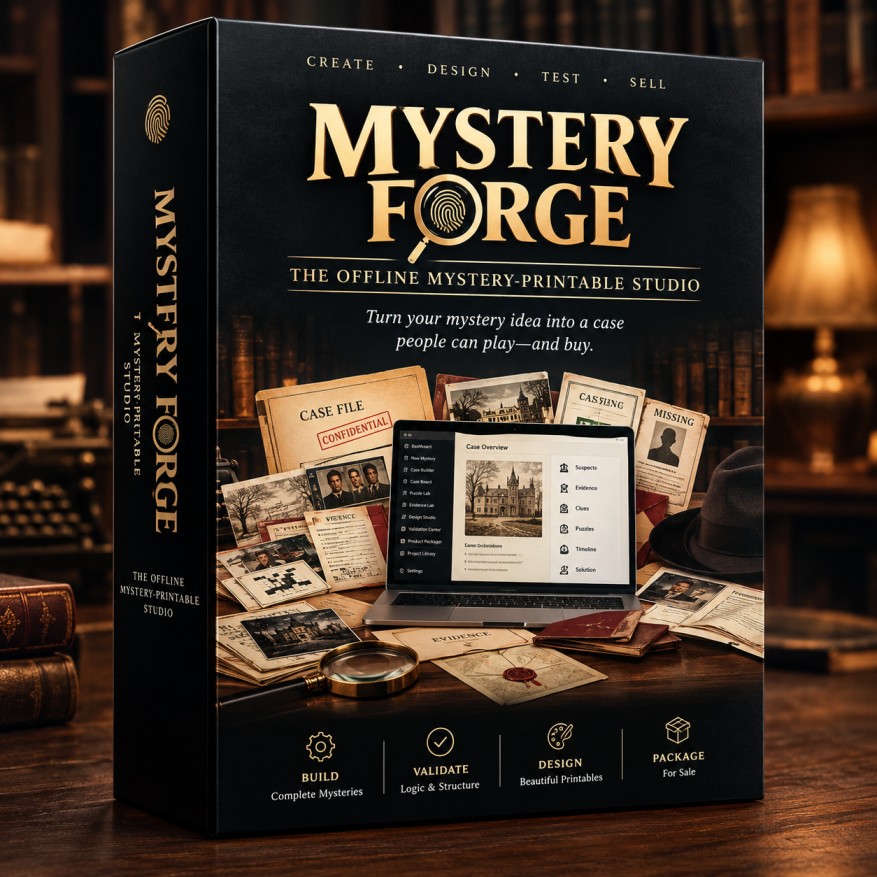 SOFTWARE BOX MOCKUP · DIGITAL DOWNLOAD
I’ll walk you through using Mystery Forge to create a case, connect the clues, check the structure, design the printables, and plan a realistic launch.
You need the case logic, the player experience, the printable files, and a clear offer to work together. Mystery Forge gives you one connected place to build those pieces.
Begin with a structured premise and an editable case blueprint. The local generator creates a starting framework; you still shape the story and review every detail.
Build suspects, motives, timelines, evidence, clues, puzzles, and a solution that can be checked against the records—not just a dramatic ending.
Design print layouts, keep player pages apart from spoilers, and draft customer-facing listing copy from the case’s real contents.
Pick a mystery type, audience, player count, session length, difficulty, atmosphere, and setting. Mystery Forge offers 18 types and 108 authored premise frames to get your first structure moving.
Decide what happened, who is responsible, why, and what would rule out the strongest alternative. Edit the generated suspects, motives, locations, evidence, timeline, clues, and host solution.
Choose among 24 puzzle categories and 53 mechanics or variants. The studio calculates supported puzzle structures and stores explanations and staged hints; check the intended reading before it reaches players.
Run 15 structural checks for references, rule-based exclusions, chronology, links, and puzzle calculations. A clean report is not a story-quality certificate; a human playtest is still essential.
Choose from 12 visual themes and four paper sizes. Generate distinct player, host, and answer-key packets plus editable copy drafts. The tool does not post to marketplaces or produce PDF files directly; browser Print can save PDFs.
Both demos are captioned MP4 guides with AI-synthesized English voiceover, embedded directly in this single-file sales page. Click Play to hear the audio; burned-in captions stay visible when muted. The interface imagery is illustrative—not live software screen recordings—and the downloadable studio is the interactive product.
A guided, chapter-by-chapter tour: choose a blueprint, connect the case, inspect puzzle answers, run sample-only structural checks, then prepare the player and host packets.
A narrated worked example at $17 USD: 20 orders, assumed 10% fees, 5% refund reserve, $50 promotion, and $10 other cost gives $229 estimated contribution before excluded expenses. Hypothetical only.
These illustrative interface previews show the kind of work the studio organizes. Use the downloadable HTML studio for the actual interactive controls.
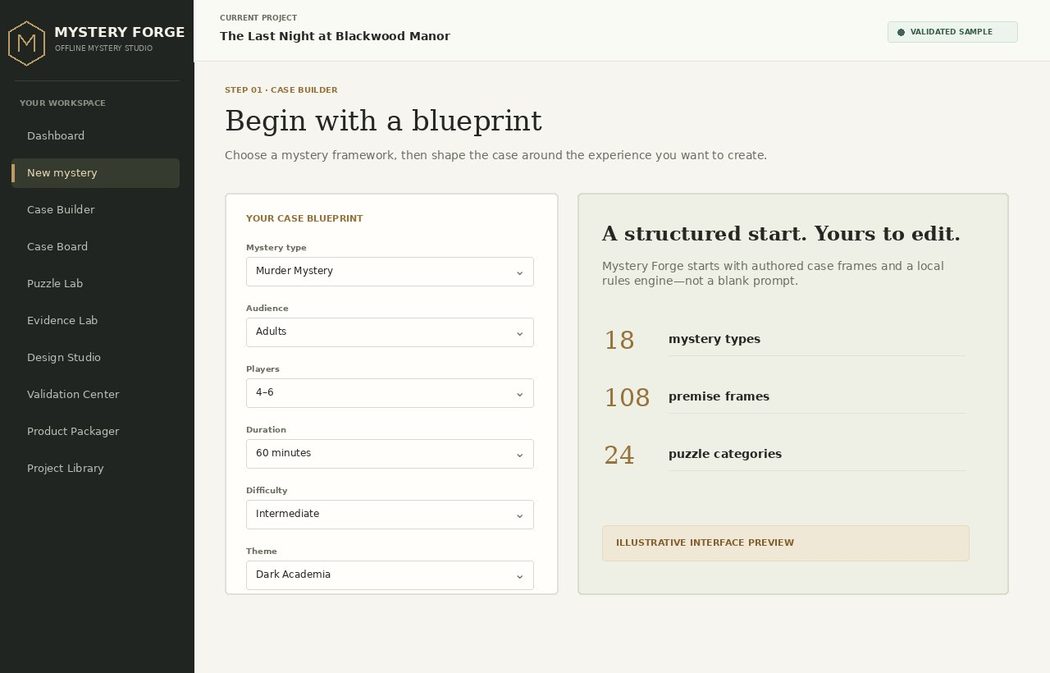
Choose a mystery framework and shape the intended group experience.
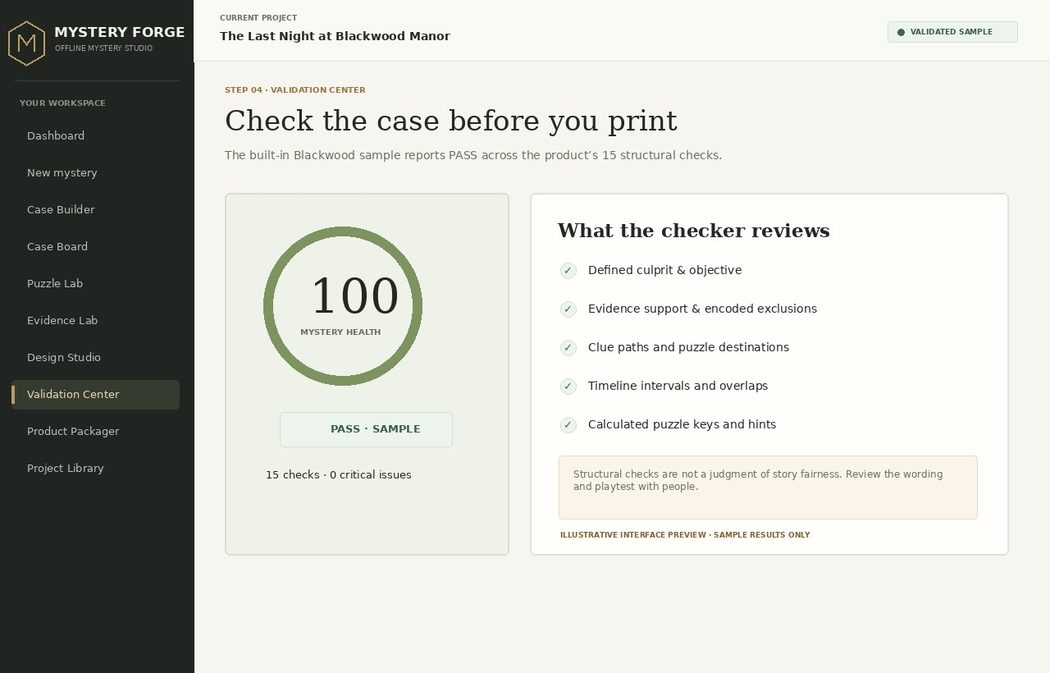
The supplied Blackwood sample reports PASS on 15 structural checks; the tool still calls for human review.
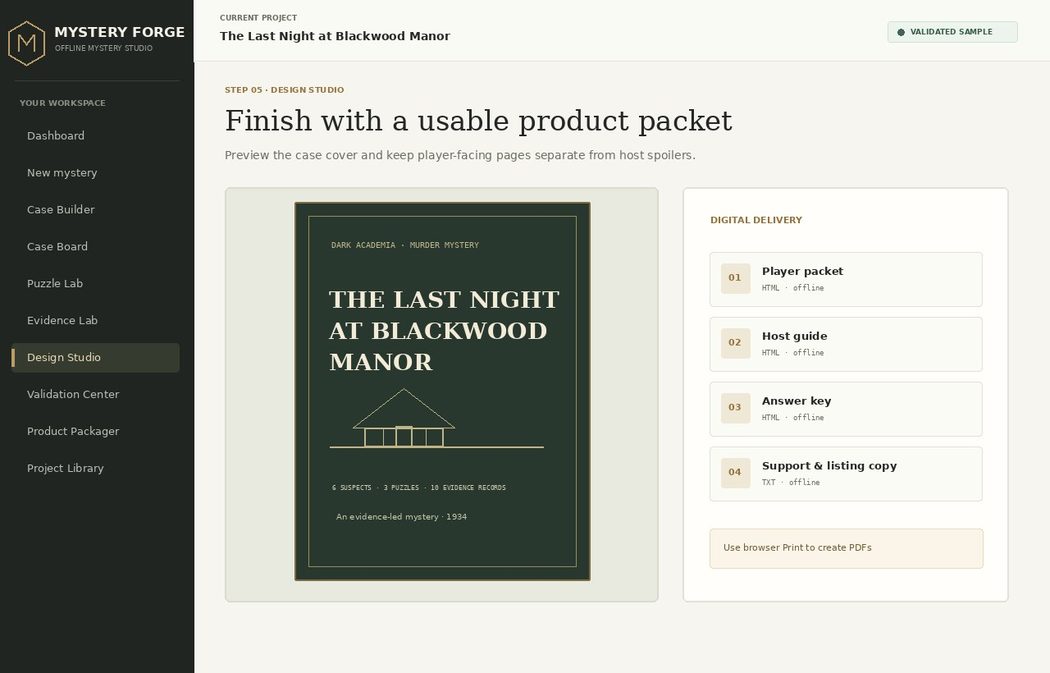
Example cover and packet map for the included Blackwood Manor sample. The product download is digital, not a physical box.
Visual previews are recreations for this sales page, not unaltered application screenshots. The sample case is fictional.
Mystery Forge is a standalone offline studio—not a cloud service, an AI API, or an automatic sales engine.
Local case frames create an editable starting point. Special requirements stay as notes for you to apply.
Connect suspects, motives, records, clues, puzzles, timeline events, and the host solution.
Run code-based checks and puzzle recalculations; then do your own editorial review and playtest.
Preview cover, evidence, puzzles and guides in four paper sizes and twelve visual themes.
Create separated HTML packets, TXT support files and editable marketplace copy. You publish it yourself.
The product can help you create a digital mystery offer. It cannot guarantee traffic, buyers, profit, marketplace approval, or income. Start with assumptions; replace them with your actual results.
Change the inputs. Outputs recalculate in your browser. These are example assumptions—not sales data.
*Before other taxes, chargebacks, currency conversion, labor, platform-specific payout costs, and any expense you have not entered. Break-even is a simplified estimate; verify it with your records.
A healthy-looking gross sales figure can still hide weak contribution. Track the costs you actually pay and make one small, measurable change at a time.
| Metric | Formula / use |
|---|---|
| Conversion rate | Orders ÷ product-page visits. If visits happen but orders do not, test the offer clarity, sample previews, price fit, and checkout friction. |
| Average order value | Gross revenue ÷ orders. Once one case is clear, test a genuinely useful themed bundle to see whether buyers value it. |
| Contribution per order | Price − fees − refund allowance − variable costs. Compare this with paid customer-acquisition cost before scaling ads. |
| Refund rate | Refunded orders ÷ completed orders. Read the reasons; clarify format, age suitability, printing, and exactly what is included. |
| Customer acquisition cost | Attributed promotion spend ÷ new customers. Tag links and count all promotion spend; don’t scale a channel you haven’t measured. |
Important: the editable examples are not my revenue, not a customer case study, and not an earnings prediction. Platform fees vary; taxes, chargebacks, refunds, exchange rates, demand, competition and promotion costs can change the result.
Illustrations below use an assumed 10% fee rate. Refunds and taxes are not included; they are not a promise or a benchmark.
Illustrative arithmetic only. Mystery Forge has no marketplace analytics and does not verify sales, fees, or market demand.
Start with one complete download for a defined audience. State exactly what the buyer gets, how many can play, the file format, and printing steps.
Once the first case is clear, experiment with related mysteries as a bundle. Compare actual order value and conversion; don't assume a bundle will sell more.
Consider classroom, facilitator, or event licenses only after you define the permitted use, check marketplace rules, and confirm rights to every included asset.
The companion assets are delivered alongside the product in the creator launch kit. The sales page now displays the $17 USD one-time offer. Add your creator name, checkout link, support address, and seller details before publishing.
A printable five-pass workbook for turning an idea into a fair evidence chain, a tested puzzle path, and a clear customer offer.
An editable XLSX with an assumptions-based unit-economics calculator, actual monthly tracker, and plain-language metric guide.
The Product Packager drafts listing text for Etsy, Gumroad, Shopify, KDP, Teachers Pay Teachers, and social—using the project’s actual details.
Explore a complete, fictional six-suspect example already inside the studio before building your own case.
The sample’s 15-check structural report returns PASS in the supplied studio. That verifies its encoded checks; it does not guarantee a particular audience’s experience.
You enjoy story, deduction, escape-style puzzles, teaching activities, or hosting— and want a structure for turning concepts into editable cases.
You prefer a standalone browser file with no account, external API, or monthly subscription. Your files stay on your device unless you choose to share them.
This is not a done-for-you store, an AI prompt service, a marketplace integration, a finished sales funnel, or a guarantee of income.
Get the offline Mystery Forge studio and its creator resources. Work through the walkthrough, edit the built-in case, and use the calculator to plan with assumptions you control.
If the studio and listed resources aren't right for you, send a request to royndrill@gmail.com within 14 calendar days after purchase. We will refund 100% of the purchase price to the original payment method, subject to payment-provider processing and applicable law. This is a product refund policy—not a promise that you'll earn money or make sales.
A downloadable, self-contained HTML application that runs in a modern browser. It is an offline mystery-printable studio with a local blueprint-driven generator, case builder, puzzle and evidence tools, validation checks, print design, and product copy packager.
No. It uses authored premise frames and structured local rules. Puzzle answers are calculated by supported algorithms. It does not call an AI service, interpret arbitrary prompts, or turn special-requirement notes into a finished story automatically. You edit and review the generated case.
No. The packager drafts copy for several marketplaces, but there are no marketplace integrations or analytics. You create or connect your own checkout, publish the listing, handle customer support, and verify all fees and platform requirements. Sales and earnings are not guaranteed.
The studio creates separate self-contained HTML player, host, and answer-key packets plus TXT support and listing copy. The companion creator playbook is HTML and the metrics tracker is XLSX. The studio does not include pre-generated PDFs; you can use browser Print / Save as PDF and check the result before distributing it.
No. Mystery Forge is a standalone browser file and is designed to work locally without an account, external API, or monthly subscription. Your project data stays in your browser/device unless you choose to export or share it.
Use a recent desktop or laptop browser such as Chrome, Edge, or Firefox for the best experience. Printing is handled by your browser. Review the print preview and choose the matching paper size before distributing pages.
The built-in Blackwood sample is a non-graphic fictional murder mystery with a suggested age of 16+. Mystery Forge also has children’s detective and classroom mystery options, but the creator should review and edit content for the intended audience before use.
Submit a refund request within 14 calendar days of the purchase date using the support email shown at checkout. The stated policy is a 100% refund of the purchase price to the original payment method. Payment-provider timing and applicable consumer law may affect processing. There is no earnings guarantee.
No. The validator checks encoded relationships, selected rule-based facts, timeline consistency, puzzle calculations, and other structure. It does not understand every sentence or prove that real players will understand the story. Human editorial review and playtesting remain necessary.
Playtest with fresh players, check print readability, review audience and content notes, verify copyright and usage rights for imported material, confirm your license and refund terms, and confirm the displayed $17 USD price, then set the creator name, support email, checkout link, and legal-page details on this sales page.
“I want Mystery Forge to help you move from an idea to a case you can explain, test, and improve. The studio gives you a structure; your judgment gives the mystery its voice. Your business results come from the product, the audience, and the work you do after export—not from a guarantee on this page.”
— The Mystery Forge creator
See what's included